
dorothy day and the good samaritan
On Sunday July 13th the Gospel reading was the parable of the good Samaritan. Luke 10:25-37. This parable is well known even outside of the Christian faith. It perfectly captures the essence of not only what makes a good neighbor, but who our neighbor is. It has always touched me; however, it particularly resonated with me considering Dorothy Day’s writings and being a Catholic Worker. There are so many who are in need in our families, workplace, communities, and world. Dorothy reminds us not to be indifferent and avoid the poor as the Levite and Priest did in the parable but to see the person in front of us and attend to them.
Perhaps the hardest thing is to keep your heart open and not become hardened to the plight of the poor and suffering. Compassion means suffering with and helping to alleviate it. The Gospel asks us to lift each other’s burdens and to bring light to the world which is often full of darkness. Dorothy not only knew and often wrote about it. She lived it.
Her immense love for Christ, and her desire to love and serve Him is what drove her. Her deep prayer life (she prayed the Liturgy of the Hours as a Benedictine Oblate six times a day) her attendance at daily Mass, her spiritual reading, love for the Eucharist, and attendance at retreats gave her the strength and spiritual food that she nourished her and sustained her and the “work” at Catholic Worker.
More than that, it brought her closer to Christ and deepened her love for Him and those she encountered at the Catholic worker house, on the street, on the soup kitchen line, and in her own family. She wrote, “I really only love God as much as I love the person I like the least.”
Dorothy wanted to bring about a change of heart and believed if each person loved as the Good Samaritan did and did their part, it would be a better world indeed. That is what the Good news of the Gospel is. We do not have to seek out where to help or volunteer. God provides opportunities for us if we listen. The Spirit nudges us to do what we need to do for the person right in front of us. As Dorothy said, “The final word is love.”
dorothy’s house
I pray every day for Dorothy Day’s canonization. For me, she is already a saint. No formal canonization needed. She is a saint I can relate to, emulate, talk to, and pray to. The more I learn about Dorothy Day, the more confident I am that it is possible for me to be a saint.
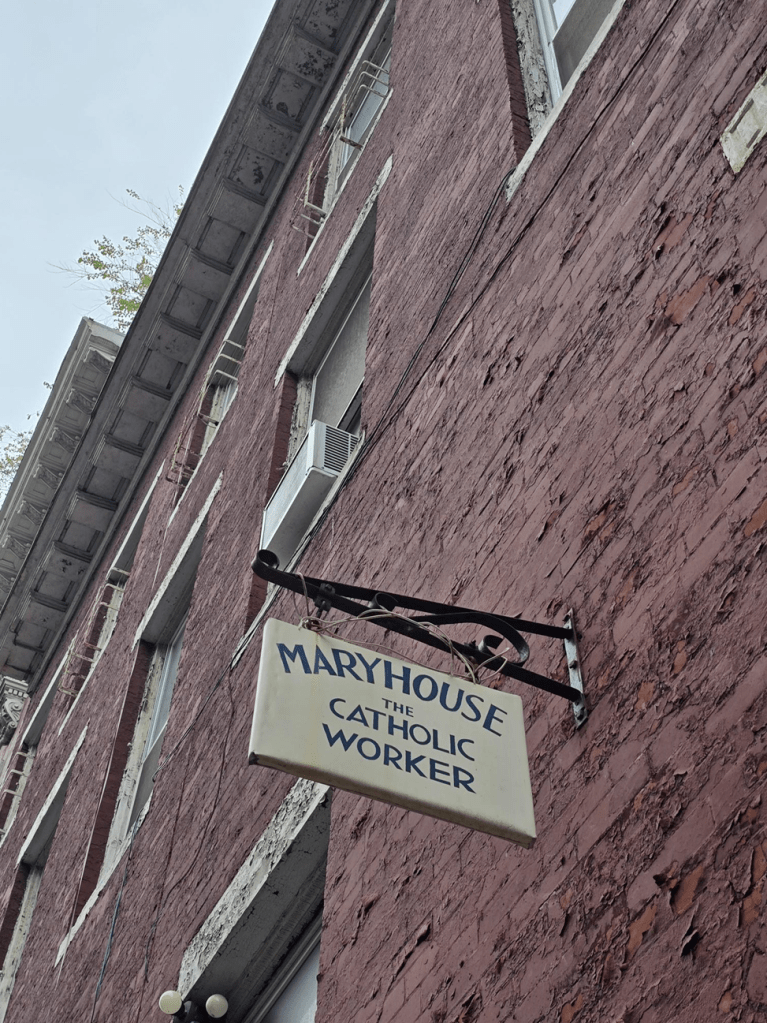
I never felt closer to Dorothy Day or her mission, as one of the founders of the Catholic Worker Movement, as when I visited Mary House at 55 East Third Street, a few weeks ago. It has been a Catholic worker house since 1975, when Dorothy purchased the property, which was originally a music school. She converted it into a hospitality center. She remained there, lived there, and died there, in 1980. The Catholic hospitality houses number over 80 in the United States and abroad, and the Catholic worker communities number over 185. The Catholic Worker Houses have one purpose, to practice the corporal and spiritual work of mercy, as described in Matthew 25:35-46.
The hospitality houses offer food, clothing, and shelter to those in need, as well as love and community to their guests, as well as their workers. The Catholic Worker Movement began on May 1, 1933, during the depression, and was founded by Dorothy Day, with the help and inspiration of French poet, De La Salle Christian Brother, philosopher, and teacher, Peter Maurin.
Saint Joseph’s House, which is located on 36th and 1st Street, New York, New York, was purchased by Dorothy Day in 1967, and has been “in business” to this very day. It continues to serve soup and hospitality.
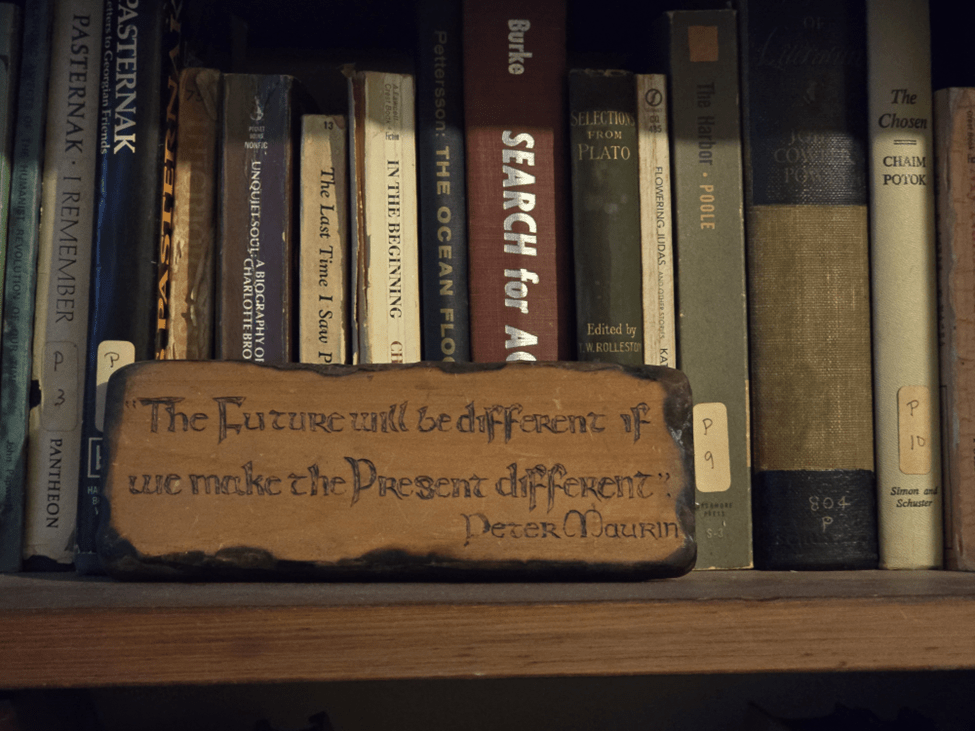
Peter Maurin once said, “We want to build a society where it is easier for people to be good.” I think he was on to something.
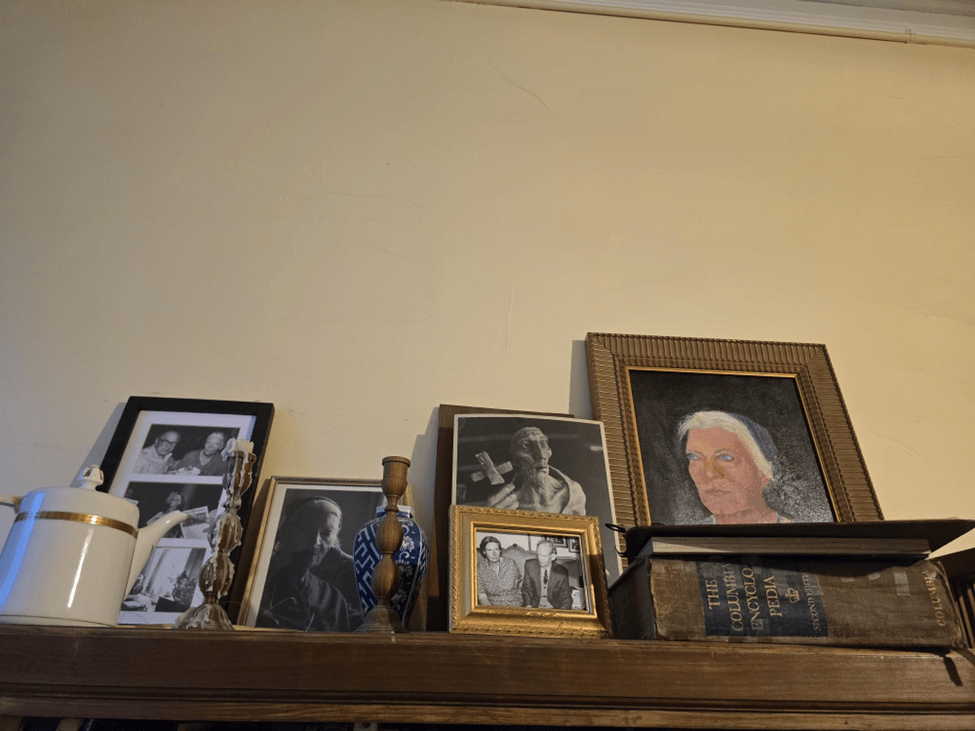
Dorothy Day was a Benedictine Oblate. Her rule of life was prayer, work, and community. I was blessed to be able to visit and spend time alone in the very room that Dorothy Day lived and died at Mary House. As I entered the room, the first thing I noticed was all the books surrounding the bed, table, and sitting room. Books were everywhere, neatly placed on bookshelves. The books surrounded Dorothy wherever she was in the room.
The room had a charming simplicity. I felt peaceful, yet alive and inspired. Dorothy’s hairbrush, personal items, her glasses, and coffee mug were placed just as if she would return the next morning. A cup of coffee and a Psalms was a daily ritual, which Dorothy practiced and loved; it grounded her. Dorothy also attended daily Mass. The Eucharist was her nourishment and food for the soul. I felt as if Dorothy would walk in at any moment, telling me to go downstairs to help make the soup and serve, as the line formed outside Mary House. Dorothy’s Spirit fills Mary House.
In every Catholic Worker community where there is soup served with love Dorothy is there and her legacy lives on.
Here is the Prayer for Dorothy’s canonization:
“God our Father, your servant, Dorothy Day, exemplified the Catholic faith by her life of prayer, voluntary poverty, works of mercy, and witness to the justice and peace of the Gospel of Jesus.
May her life inspire your people to turn to Christ as their Savior, to see his face in the world’s poor, and to raise their voices for the justice of God’s kingdom.
I pray that her holiness may recognized by your church, and that you grant the following favor, that I humbly ask her intercession. I ask that this in Christ Our Lord” AMEN!
Please join us on the third Monday of every month at Holy Child Church 7:00 PM-8:00 PM to pray for Dorothy’s canonization. It is a night of Prayer, Exposition of the Blessed sacrament, Recitation of the Litany of the Poor followed by discussion.
Will you help us have our own Catholic Worker House on Staten Island. Please consider becoming a monthly donor. Click on online giving on the website and mat God Bless You!



who is dorothy day?
I recently had the privilege of attending a Catholic Worker event in Harrisburg, Pennsylvania. Martha Hennessey, the granddaughter of Dorothy, was the guest speaker. Martha is the second-youngest child of Dorothy Day’s daughter, Tamar. She was one of Tamar’s nine children. She is a peace activist, Benedictant ****, (like Dorothy) member of the Catholic Worker Movement. She splits her time between Vermont, where she lives on the farm where she grew up, and Saint Mary’s House and Saint Joseph’s House in New York City, where she volunteers, and where Dorothy lived, in Mary’s House.
Her gray hair is pulled back in a bun, and she is soft-spoken and small in stature. One can see the resemblance to Dorothy in her steel-blue eyes and in her soul. She will be 70 on July 11.
She was very honest about how she had left the church, but returned in her fifties. What struck me more about Martha was her dedication, honesty, and loyalty to Dorothy’s legacy. She said Dorothy was steadfast in her faith, and to the church. She said, “Dorothy’s piety frightened me.”
Martha realized that Dorothy’s time praying and daily attendance at mass, as well as the retreats and pilgrimages she attended, gave her the strength and grace to be able to do the work. It is not easy loving what and who we see as “unlovable” as Dorothy would say; but as Dorothy and Martha understand, it is Jesus who they are loving in ministering to the poor.
The love and grace we receive from Christ is what fuels our love for others, wanting to bring Jesus to others, as well as serve Jesus and build up his kingdom. Martha was approachable and down-to-earth, much as her Grandmother.
I asked her during lunch what memory came to mind when she thought of Dorothy. She stopped for a moment, and looked out into space, and did not say anything. After a few minutes, she then said, “rocking in the chair on the porch at the farm, and being held by her.” She then added, she was so present to me. It was heartfelt and touching.
Dorothy Day is a saint for all of us. Grandma, activist, saint, sinner, writer, friend, mother, and lover of the poor.
She is an inspiration. The more I learn about Dorothy, the more I feel there is hope for me too.
what would dorothy day say about pope leo xiv?
I am sure Dorothy Day would be gleefully happy with the election of Pope Leo XIV. The fact that he is a fellow Chicagoan (Dorothy lived in Chicago from 1906 until she was 18 and moved to New York City) and the first American Pope as well as being an Augustinian, a missionary, a champion of peace, a lover of the poor, and he took the name Leo XIV in honor of Leo XIII whom is considered the Pope of Catholic social teaching would certainly please Dorothy.
I’m sure Dorothy would be filled with gratitude, praise, and hopeful expectation of the reign of Pope Leo the XIV. Dorothy was a faithful and loyal daughter of the church. Pope Leo XIV was an admirer and follower of Pope Leo XIII, whose Catholic social teaching was written in his encyclical Rerum Novarum which he issued on May 15, 1891. Rerum Novarum explicitly addresses the condition of the working class. It was subtitled “On the Conditions of Labor,” and Pope Leo XIII stated that “According to natural reason and Christian philosophy, working for gain is creditable and not shameful. For a man to enable him to earn an honorable living.” (paragraph 20) Pope Leo asserted the “dignity of every human person endowing them with free will and immortal souls.” He championed the rights of workers unions and asserted that every person should be able to earn a livelihood and be able to take care of themselves and their families.
“Workers should be given time off to worship God and to fulfill family obligations, and to be able to rest.” (paragraph 17) He wrote how the poor and working class should be protected by the state and government, and the government’s purpose was to support the common good and have a just and ordered society. The Catechism in the Catholic church identifies and defines Catholic social teaching and the common good as follows:
1. Respect for the human person and his rights
2. Social well-being and development
3. Peace “the stability and security of a just order.”
Leo XIII condemned socialism as the state would have too much power over the lives of individuals and family. He envisioned a cooperative workplace and supported private property, emphasized how those with more are to help the less fortunate. Pope Leo XIII found socialism as flawed, as it sought to replace rights and Catholic moral teaching with state power.
“Whoever has received from a divine bounty a large share of temporal blessings, whether they may be internal and material, or gifts of the mind, has received them for the purpose of using them for the perfecting of his own nature, and, at the same time, that he may employ them, as the steward of God’s providence.” We are to live the gospel and use our gifts to help carry and lift others’ burdens.
Pope Leo XIV, it is said, sees the need for a renewal in this Catholic social teaching, especially in the age of AI, corporatism, and elimination of many jobs and small businesses due to the advancing technological age.
Dorothy Day has a kindred spirit in Pope Leo XIV. The Catholic worker philosophy was one of peace, presence, and prayer, what I call the three P’s. She worked for justice and to reform social structures that lead to poverty and oppression. She, with Peter Maurin, in 1933 published the first Catholic worker newspaper dedicated to promoting Catholic social teaching and passivism. Dorothy perhaps explained the essence of Catholic social teaching best. “To feed the hungry, clothe the naked, shelter the harborless without also trying to change the social order so that people can feed, clothe, and shelter themselves is just to apply palliatives.” Dorothy and Pope Leo XIV know ultimately that man alone is weak, and there is a constant battle between good and evil in the world and in one’s soul. The ultimate way to peace, justice, and love is THE WAY. The more we follow Jesus, who is THE WAY, and conform to him and his will, the better we will be, and the world will be. The Catholic Worker touches one soul at a time and builds community with the poor as well as those who serve them.
Let’s pray for pope Leo XIV and ask for Dorothy Day’s intercession to help him to be a lead his flock.
easter and resurrection
As we are in the season of Easter, I wanted to write about the joy and promise of resurrection from Dorothy Day’s perspective. I went to the source. In her book, “The Reckless Way of Love, Notes on Following Jesus.” I, of course, found immediate inspiration. As I reached for the small paperback, it opened to the following page. “It is really a great faith in love that never dies. …” Page 101.
“I am speaking of heavenly things, but heaven and earth are linked together as the body and soul are linked together. We begin to live again each morning. We rise from the dead, the sun rises, spring comes around – there is always the cycle of birth and growth and death and then resurrection.” Page 102. The passage is a beautiful testament to Dorothy and the Catholic Worker Movement as it was envisioned by Dorothy Day and Peter Maurin.
Every day, we begin again and see Christ in our daily encounters with the poor, whether they are physically or spiritually in need. Dorothy Day would at times be discouraged by the overwhelming needs and suffering she saw daily. However, she also knew she was not their Savior and could not eradicate all the problems of the poor. Instead, she faced them head-on, one-on-one, with each person who came to St. Joseph House or the Mary House. She saw Jesus in them and knew that besides a hot meal, clothes, or a place of shelter, they needed love, acceptance, and to be recognized as they were. It was not easy, and some were very hard to love, but Dorothy did it anyway. She did it for Christ. One soul at a time.
Love is not a feeling but a choice. She and those at the Catholic Worker would be Christ’s hands, feet and voice in feeding and loving those in need. To give love, we must have love, the love of Christ that He has given us as shown through His death and resurrection.
Dorothy Day knew we must feed our souls to feed others. She prayed the Liturgy of the Hours, was a Benedictine Oblate, and lived a life of Benedictine spirituality, prayer and work.
Community, support, and love are among the Catholic Workers was extremely important to her. Just as the first Christians loved on another and modeled that love to others in spreading the Gospel so does the Catholic Worker. She could not do the work alone, and neither can we.
“The only answer in this life to the loneliness we are all bound to feel, is community. The living together, working together, sharing together, loving and loving our brother, and living close to him in community so we can show our love for Him.” Page 104 to 105.
Community that the Staten Island Catholic Worker is building through our prayer group, the Masses for Peace, our talks, discussions, the volunteer meetings and events is of great importance. The purpose is to foster a sense of belonging, purpose, love, and support for one another, as well as the poor we serve.
We need each other to serve and to do the work. Everyone’s contributions, whether they be prayers, financial support, heading one of our initiatives (sandwich outreach, soup kitchen, or community meal), serving, cooking, performing administrative tasks, is all invaluable in our mission to spread the word about Dorothy Day, support her canonization, and to promote the Catholic Worker Movement as envisioned by Dorothy Day and Peter Maurin. We need each other, and are grateful for all the love, and support that has been given.
At Easter, we renewed our Baptismal promises. Loving, willing the good of the other, and building the kingdom with each other and the poor is what we are called to do as Catholics, and we wait for the promise of eternal life.
Dorothy Day, pray for us.
DOROTHY DAY AS A SPIRITUAL MENTOR AS WE APPROACH HOLY WEEK
As we prepare for Holy Week, which begins Palm Sunday on April 13, and as Lent winds down, it is not a time to become complacent or lax in the spiritual disciplines and pillars of Lent – namely, prayer, fasting, and almsgiving.
We should turn to Dorothy Day for further inspiration, motivation, and encouragement to continue on. For those of you who feel you have not lived up to your Lenten promises, namely, prayer, fasting, and almsgiving, take heart in this quote from Dorothy Day, “Don’t worry about being effective. Just concentrate on being faithful to the truth.” It is not too late.
PRAYER
There is still time to pray. Dorothy believed in the power of prayer and especially loved the Psalms. She prayed the liturgy of the hours daily and she attended Mass daily. Once of her famous quotes was this, “With prayer, one can go on cheerfully and even happily, without prayer, what a grim journey.”
Perhaps, as we approach Holy Week, read Psalm 51 and pray for mercy and forgiveness for yourself and for those you need to forgive. Peace was of utmost importance to Dorothy and the Catholic Worker Movement.
FASTING
“Food for the body is not enough. There must be food for the soul.” Dorothy viewed fasting as a way to identify and manage adversity, and as a means to show love for those in need, rather than solely as a penance. It also shows solidarity with the poor- to suffer in hunger with them.
The reason to fast is to hunger for God. Only he can give us life, as Dorothy stated in one of her quotes, “Our Creator gave us life and the Eucharist to sustain life.”
Dorothy Day and Peter Maurin saw almsgiving not just as charity, but a radical act of justice, and a way to transform society. “The best thing to do with the best things in life is to give them away.” Dorothy famously said.
“What we would like to do is change the world – make it a little simpler for people to feed, clothe, and shelter themselves as God intended them to do.” Dorothy Day.
Keep up your Lenten penances, and prepare prayerfully for Holy Week, and look to Dorothy for encouragement,
“Obedience, fasting, prayer, are laughed at, yet through them lies the way to true freedom.” Freedom to love and serve.
To help the less fortunate, peace and prayer is our mission at Staten Island Catholic Worker. Any donations to further our mission would be greatly appreciated. We are eternally grateful to all of our supporters, for your donations, as well as your prayers, and may God continue to bless you. You are a part of the mission and vision of Dorothy Day.
MEDITATION ON DOROTHY DAY AND LENT
HOW IS YOUR LENT GOING? by Anne-Louise DePalo
What I love most about Servant of God Dorothy Day is how “real” she was in her personal and spiritual struggles. She is someone I can relate to in my own difficulties with and striving to achieve holiness and sanctification.
How many of us have made a resolution for Lent but in attempting to carry it out we do more harm than good? The purpose of the spiritual disciplines of Lent are supposed to bring us closer to Christ and be more like Him, especially when encountering others. If we are having the opposite effect, we may need to rethink what we have chosen as our Lenten penance or sacrifice.
I had to chuckle when I read that for many years, Dorothy tried to give up smoking. Dorothy was a chain smoker, so this was very, very difficult for her. Her sudden abstinence from nicotine caused Dorothy to become more demanding, cranky, and short tempered. The entire Catholic Woker community were on edge and asked her to resume smoking during Lent. Even her spiritual director told her to reconsider her Lenten sacrifice.
Can you relate? I know I can. Been there, done that. Perhaps not with smoking, but by taking on unrealistic fasts, giving up meat, not sleeping, you can fill in the blanks.
What is more miraculous and edifying about this story though is not only can we identify with Dorothy’s humanness, but that we can also emulate Dorothy; she kept praying for help from God to lessen her desire for a cigarette. She knew that it was not only an unhealthy habit, but the money that she spent on cigarettes could also go to the poor. She continued to pray and pleaded with God to aid her in her weakness. She knew she needed God’s help.
One day, she just stopped smoking. The need for nicotine was gone. She had no desire for cigarettes any longer, giving God the credit and glory. Again, in Dorothy’s life, we can see that she had total dependence and trust in God. We can do nothing without Him during Lent and any other time of the year.
Radical Lent
A Radical Lent by Anne-Louise DePalo
Lent begins March 5, 2025. Lent is a time to reflect on our relationship with Christ. The spiritual disciplines of prayer, fasting, and almsgiving help us reorient our lives toward Christ.
Dorothy gives us a wonderful perspective on Lent, as only she can. She said that “Lent is a wonderful time to begin again.”
In prayer, we spend time with Him and listen to His voice. We also pray for others. Fasting helps us to hunger for God, only he can satisfy us. Fasting helps us experience poverty, the struggles of the poor, and unite with them. Almsgiving opens our heart to be generous and care for the needs of others.
In essence, The Catholic Worker embodies the spirit and purpose of Lent. Dorothy’s life was a life of prayer and radical love. Seeing Christ in the poor. Her spirituality was living the gospel particularly the Beatitudes and Matthew 25.
I urge and pray for everyone to begin again this Lent and walk with Jesus on the way to radical love.
What is radical about love?
by Anne-Louise DePalo
I attended a day retreat at Saint Catherine of Sienna Church recently. I was there to get away from my everyday duties, responsibilities, commitments, and to spend the day in prayer. I walked in and a magazine called the Sunday Visitor, at the back of the Church, caught my eye. The front-page cover had a picture of Dorothy Day and was entitled, “Radical Love, Living the Gospel on the Streets of Dorothy Day’s New York.”
It seems Dorothy is ever present in my life, and it felt that she with the aid of the Holy Spirit was again calling to me. It was as if she said, “You can run but you can’t hide.” A retreat is wonderful and what Dorothy would also do to renew and refresh but the work awaits.
The article by Valerie Stivers is excellent and well worth reading. It details the Catholic worker houses still in the city, the Mary House for Women and Saint Joseph’s House for Men. Mary House is where Dorothy died and her granddaughter, Martha Hennessy, in the article says she feels Dorothy’s presence there. They encourage visitors and attendance at their nights of reflection.
Ms. Stivers stresses how these “landmarks” stand out and are a sharp contrast to the surrounding area of shopping, cafes, and townhomes in Greenwich Village. Dorothy and the Catholic Workers remain a beacon in the neighborhood, still reminding us of what the Gospel calls us to do amidst the worldliness of the area.
The article is a celebration of Dorothy and lists the places in New York City and in our own Staten Island that Dorothy visited and lived. It mentioned Saint Joseph Catholic Church where she attended Mass in the village, a park she frequented, and the Spanish Camp at Huguenot Beach where Dorothy lived, as well as Dorothy being buried in Resurrection Cemetery in Staten Island. There was also a quote from Staten Island Catholic Worker founder, Deborah Sucich, about her hearing and answering Dorothy’s call. Deborah has started a successful Catholic Worker on Staten Island. I quote Deborah, who so perfectly and succinctly stated what Catholic Worker is all about. “It’s really about the spiritual and corporal acts of mercy; it attempts to live out the gospel in a more radical way.” Sunday Visitor, January 2025, at Page 44.
For myself, this article brought me closer to Dorothy. Dorothy is ever present for me, especially after reading her writings which has helped me delve deeper into her spirituality. I also live on the very beach Dorothy walked and lived on. I volunteer at Catholic Worker in Staten Island.
All of this leads me to ask the question Dorothy Day and the Catholic Worker movement poses: Am I living the gospel in a radical way? Have I changed? Do I live my life differently or am I just going through the motions. Do I play it safe by simply attending Church, practicing some devotions, but remain comfortably the same? Where am I giving my time, talents, and money? Am I serving Christ’s Church, the poor, and those in need?
Dorothy pushes me to dig deeper, pray more, give more, and live a radical life of love. If we all ask this question in the affirmative and answer Dorothy’s call in our own way, what a different world it would be.
pray abundantly
THE NINTH AND LAST PROVOCATION OF DOROTHY DAY – PRAY ABUNDANTLY
I was sad to read the last provocation of Dorothy Day. These nine provocations have been a source of inspiration, wisdom and hope. A gift to chew on, try on, meditate on, and incorporate into my thoughts, life, and very soul. The provocations have changed me and helped me have a better understanding of myself, Dorothy, the Catholic Worker, and Christ. These provocations named and written by Dorothy’s granddaughter Kate Henessey were insightful and very touching. Through Kate’s reminiscing and writing about her grandmother one can see the influence Dorothy has had on her as a writer, as well as a mother, daughter and wife.
Dorothy, in her later years, said, “If I did not believe profoundly in the primacy of the spiritual, and the importance of prayer, these would be hard days for me, inactive as I am.” Dorothy always knew prayer and her relationship with Christ was the only way to do “the work.” Now, as she was getting older, she was not physically able to join marches, clean, cook, or travel as she once did – she prayed to come to terms with her job being, “to pray now.” Kate Hennessy says Dorothy believed that writing, the arts, poetry, and music were all forms of prayer. These became more important to her as she aged, and she continued to participate in them as a form of praise, prayer and contemplation.
One of my favorite definitions of prayer is from Saint Therese of Lisieux, whom Dorothy had a great devotion to. Dorothy wrote a biography about this great saint. I highly recommend it if you have not read it. Therese’s “Little Way,” small acts of love, mirrored and was an inspiration for Dorothy’s vision and work for the Catholic Worker.
Saint Therese said, “Prayer is a surge of the heart; it is a simple look toward heaven.” Contemplative prayer is leaning your head on Christ’s heart, like Saint John, or sitting at Christ’s feet, like Mary of Bethany.
Prayer cannot only change things; it can change you. Without prayer, each morning I find my life is chaotic, and all the threads of my life feel as if they are fraying. Prayer brings the threads together making my life whole, united, and with purpose. Prayer is that connection with God, knowing He’s always with me. He walks with me in good times and bad. For any relationship to be strong and healthy it requires time and attention, or it will break apart. We cannot love or know someone unless we spend time with them. Quality time – being present giving someone one-on-one attention, listening in silence is a gift. This is true of our relationship with God as well with others.
We must first experience the unconditional love of God before we can love others or ourselves. Dorothy is a great model for us. She teaches us the importance of prayer and how to pray. She found mercy and forgiveness in prayer, and it changed the trajectory of her life.
Dorothy found God in nature and her surroundings. She loved the sea and all forms of nature. It was a place of peace and connection to God, the source of all. She found solace in reading the Psalms – full of praise, thanksgiving, and mercy. Dorothy battled every day to stay true to herself, not lose sight of her purpose, and surrendered the outcome and her life to God. Dorothy knew the Catholic Worker was not Dorothy’s work, but God’s. She was merely His chosen instrument, and she could do only what she could do at any particular stage of her life. Prayer helped her accept, surrender, and love.
Prayer and that union with Christ, being guided by the Spirit, was the foundation of each of Dorothy Day’s provocations. To recount them, they are as follows:
1. Make yourself deeply uncomfortable.
2. Follow your conscience.
3. Find your vocation.
4. Face your fears.
5. Fail gloriously.
6. Embrace beauty.
7. Laugh.
8. Love.
9. Pray abundantly.
As Kate Hennessy said of her grandmother, “To simply admire Dorothy Day is not enough. If you are going to pay attention to her, your life will be turned on its head.”
I would add, your life will be turned on its head, and your heart will be broken in two. This gift of a broken heart allows us the space to receive God’s love, the love of others and to give love to God and to others for love’s sake. That is the key to charity, holiness and what makes Dorothy a saint.
Love hurts
The Eighth Provocation of Dorothy Day: Love
I was not surprised to find that one of Dorothy Day’s favorite quotes about love was from Dostoevsky, “Love is a harsh and dreadful thing compared to the love in dreams.” In reading this provocation, I could not help but think of the song “Love Hurts” performed, ironically, by the band “Nazareth” and written by Felice and Boudleaux Bryant. The lyrics are as follows:
“Love hurts, love scars
Love wounds and mars
Love is like a cloud
Holds a lot of rain
Love is like a flame
It burns when it’s hot.”
Kate Hennessy, Dorothy’s granddaughter, writes in her article “The Nine Provocations of Dorothy Day” that Dorothy frequently quoted Dostoevsky’s other famous quote, “The world would be saved by beauty,” but she added, “What is more beautiful than love?” Kate Hennessy says Dorothy felt there was nothing else worth writing about. “So much of her writing was on the meaning of love, the practice of love, the work of love.” Catholic Worker IV, The Nine Provocations of Dorothy Day, October-November 2023.
Dorothy loved deeply, and as a result, she had her share of heartbreaks, broken friendships and relationships. Dorothy knew that God is Love, and the Trinity shows us what love is – unity, harmony, and communion. Thomas Aquinas defined love as willing the good of the other. In essence, that is what God’s love is for us, wanting to give us divine life and for us to be with Him for eternity through holiness and transformation.
There are three types of love:
1. Filial, the love that we share with friends;
2. Eros, romantic love;
3. Agape, self-giving, sacrificial, unconditional love which was embodied by the Love of Christ. It is a pouring out of self.
Dorothy experienced love in every form. From her friendship with Peter Maurin, her love for Tamar’s father, the love she had for her daughter, Tamar, and the love of Christ. Christ’s love called Dorothy, and she spent the rest of her life answering that call. After her conversion she tried to live that agape love through prayer, her devotion to the Eucharist, the Church, and through her service by founding and working at The Catholic Worker.
Dorothy knew love is like a burning flame that must continually be stoked, not allowing the embers to become cold and the fire extinguished.
Dorothy recognized the importance of community and building “houses” that welcomed individuals in need of love. One act of love at a time is Dorothy’s life purpose and charism. To say to someone, “You matter,” by calling them by their name, giving them a warm smile, asking if they are hungry, serving them a cup of hot chocolate, coffee, or a grilled cheese sandwich. Simply looking directly into someone’s eyes when you speak to them can demonstrate love.
Even those of us who give out the sandwiches, serve at the community meals or at the soup kitchen also need to experience fellowship and community. To feel we belong. We all share a common goal and care about each other. This also demonstrates love. For, love is the reason that brought us to do the “work”. Dorothy fostered this in the houses that she founded. It is love for the poor as well as for the workers and volunteers.
Unfortunately, in society today, love, instead of being an active word, has become more of an emotion. Love is not always easy. Nor is love infatuation or pure bliss. Love requires sacrifice, and it is only through suffering and sacrifice that we can become transformed into Christ.
As I read the passage on love by Kate Hennessy, I could not help but think of Dorothy’s relationship with Forster Batterham, who was the love of her life and father of Tamar. He left her and Tamar and eventually found someone else. Though Dorothy loved him with all her heart, because he would not get married in the Church and raise Tamar Catholic, she knew that she could not continue the relationship because her Catholic faith meant more to her than her love for him.
Dorothy, however, did not cease to love him, and she demonstrated that love is willing the good of the other by caring for him when he was ill and visiting him at the hospital, now Richmond University South in Staten Island. She also took care of his common-law wife who lived close to Dorothy on Staten Island in the Spanish camp. If that does not demonstrate heroic virtue and true love, I do not know what does.
Dorothy Day, through her life, work, and writings, shows us that we are all capable of becoming saints no matter what we have done in the past, what mistakes we have made, or where life has taken us. Dorothy Day not only experienced, reflected on and wrote about love, she personified it.
laughTER
DOROTHY DAY’S SEVENTH PROVOCATION
LAUGHTER
I am a firm believer that laughter is the best medicine. I was thrilled to read Dorothy Day’s Seventh Provocation which is to laugh and not take yourself too seriously.
Kate Hennessey in her article entitled “The 10 Provocations of Dorothy Day”, the 7th provocation, is to LAUGH. Ms. Hennessey describes her grandmother’s laugh as “a joyous high-pitched girlish giggle.” I can only imagine what it must have been like to have heard that laugh.
Ms. Henessey writes that Dorothy and her mother, Tamar, “found humor in the absurdity of the human condition and the joy of it.” (Page IV Catholic Worker/November 2023). What insight and wisdom these women had. A sense of humor is necessary to enjoy life and not become weighed down by our own failings, the failings of others, and the world’s problems. It helps us from becoming maudlin and egotistical. A sense of humor and being able to laugh at oneself is a sign of humility. Without humility it is impossible to become a saint.
The world does not need joyless saints as Saint Theresa of Avila has said. Laughing at certain incidents or our shortcomings can help us accept God’s love and mercy and allows us to reach out to others– sharing our commonality.
GK Chesterton, one of my favorite Catholic writers and apologists had a brilliant and comedic flare, and one of my favorite quotes from him is, “We are all in the same boat, and we are all seasick.” This quote alone makes me chuckle.
The sound of laughter lifts your mood and touches your soul. An infectious laugh is contagious. When there is an awkward moment or tension, a smile coupled with a humorous quip that sums up the situation can break the ice and get everyone to relax and see the humanity of the other. I often use humor in mediation and in court to allow the parties and opposing counsel to see that what they may be focused on is not as important as they think in the scheme of things. Humor can help you see the forest through the trees. It can also put out fires. This is a much better choice than choosing to add kerosene with angry words or aggression and further enflame a hurtful or difficult situation.
There is also research that humor helps people heal physically, mentally and emotionally. There was a study of patients that watched slapstick comedy, and they healed at a greater rate than those who did not.
Kate Hennessey said Dorothy often quoted John Ruskin (an English polymath – a writer, or historian, or critic, draft man, and Victorian philosopher and philanthropist) who wrote about “the duty of delight”. This is an inspiring and thought-provoking quote.
I think of how God takes delight in us, as the Psalms say, and how he wants us to take delight in Him. How marvelous is that? Dorothy Day understood and continues to inspire and amaze me. I certainly delight in her and her advice, humanity, and wisdom which penetrates my soul.
The challenge for this provocation is to ask yourself when was the last time you laughed until you cried? Or when was the last time after being with someone or with a group of people your face hurt from laughing so much? Maybe it is time to laugh.
I have a suggestion. Check out the scene from of the chocolate factory with Ethel and Lucy or the crushing of grapes when Lucy tries to make wine from the classic television show “I Love Lucy.” Another suggestion is any of the Marx Brothers’ movies, or the Little Rascals. A good laugh goes a long way. Bob Hope a practicing Catholic said, “Laughter is a gift, and I intend to share mine.” If we all did that what a better world it would be.
Embrace Beauty
The Sixth Provocation of Dorothy Day – Embrace Beauty
By Anne Louise DePalo
This provocation is perhaps my favorite. Dorothy (like myself) often meditated and reminded herself of the quote by Dostoevsky, “The world will be saved by beauty.” I know this to be true not only for the world but for my own soul.
Beauty is defined in the Catholic tradition as a quality of existence which points to God. Beauty pleases on the surface level, but also in the deepest parts of our heart. It is the marriage of goodness, truth, and love.
Dorothy could and chose to find beauty wherever she was. She loved Staten Island and saw its beauty and unique quality. When she looked out on the Raritan Bay from her bungalow on the beach she saw the horizon, the seagulls flying above, watched the ebb and flow of the tide as the sun rose before her. She did not look to the nearby wood pilings, piers, or trash on the shore. She saw the trees, gardens, and woods around her as she walked and focused on that, not the landfill Staten Island was famous for at the time. She had a talent for seeing beauty all around her.
Dorothy also saw beauty in the faces of the people she met – the smile of a toothless homeless woman, the laughter of a child in need of a bath and new clothes, the expression of intensity and commitment in her fellow Catholic workers.
Dorothy’s spirituality was about presence and awareness and the search for beauty. Beauty leads to gratitude and thankfulness. There is so much to “see” around us. While at a red light as I rush to court on a regular work day, I turn and see the bloom of a flower. In the autumn as I am driving my eye sees a beautiful red tree with the sunlight glistening on the leaves. I see a squirrel sitting on the telephone wire carrying nuts. As I walk, I hear the birds singing. Even though I cannot find them I know that they are there. I hear the wind rushing through the trees as the leaves fall. A snow-covered lake untouched and brilliant in the glistening sun fills me with wonder. In all of this we find God and know he is always there if we but just notice. We are so blessed to have four seasons and so many opportunities to be mesmerized and awed by God’s creation and goodness.
Dorothy’s granddaughter, Kate Henessy wrote, “What else is beauty but the language and love of God?” That is so true. It is a universal language we can share. Henry David Thoreau said, “An unexamined life is not worth living.” Wise words and a sentiment Dorothy would no doubt share. This is the key to living a spiritual life. I might add, “That a life without being aware of, seeing, and appreciating beauty is not worth living. Beauty brings us and the world closer to God. Another Thoreau quote which I think best sums up Dorothy’s life and her ability to embrace beauty is, “It is not what you see but what you look for.”
In 2025 let’s look for and share beauty as Dorothy did.
Fail Gloriously
The Fifth Provocation of Dorothy Day by Anne-Louise DePalo
“I feel like an utter failure,” Dorothy wrote these lines when she was 79, 45 years after she and others walked to Union Square in New York and began selling the Catholic Worker paper for a penny. Kate Henessey, Dorothy’s granddaughter, opened with this quote as she continued in her article on the nine provocations of Dorothy Day.
Do not become downtrodden or lose hope by Dorothy’s words. The next quote in the article by Dorothy, puts this feeling of failure, which we all share in perspective, “The older I get, the more I feel that faithfulness and perseverance are the greatest virtues – accepting the sense of failure we all must have in our work, and the work of others ground us– since Christ was the world’s greatest failure.” Take heart she writes, “Christ understands us when we fail.”
One can only imagine how Dorothy over the years became discouraged and weary in trying to “change” the world, evangelize, spread the mission of the Catholic worker, be a mother, grandmother, and striving to become a saint, which is the task of every baptized Christian
As I read these quotes, I thought to myself how ironic that recently, when I was feeling as Dorothy was, it was her words and spirituality that helped me the most. It never ceases to amaze me how the Spirit works. The idea of personalism – helping one person at a time in whatever way we can and with love is what matters. Doing this in our vocations, daily life, and allowing God to direct our path is the key to Dorothy’s spirituality. I now realize there is only one Savior of the world, and I know it is not me. As Saint Teresa of Avila said, we are to the Christ hands, his feet, and his mouth on earth. That is all we can do and be.
Dorothy wrote to William James, “I am done with great things and big things, great institutions and big success, and I am for those tiny invisible molecules moral forces that work from individual to individual, creeping through the crannies of the world like so many platelets that heal wounds or like the capillaries oozing of water and oxygen into the cells yet which, if you give them time, will rend the hardest monuments of man’s pride.” Dorothy knew there was no heaven on earth. The key is not to give up, “to pick yourself up, dust yourself off, and start all over again”, as the song goes.
Whenever I am down, feel I have failed, have regrets, or think I haven’t done enough, I lick my wounds and know I must take time to rest, retreat, and nourish my soul and body. I spend time in prayer, asking God to give me the strength and grace to carry on.
It is often in our failures, we learn humility. Perhaps we must take a slightly different path. Are we doing too much? “Are we “doing” and not also “praying?” Are we becoming a Martha rather than a Mary – acting without Christ by our side, allowing Him to direct our way? Am I being goal-oriented and ego driven? Am I expecting perfection in myself and others?
It is so easy to think we can have heaven on earth. That is not possible. All we can do is to try to make the world a better place by creating Holy moments and spreading the love of Christ and let them experience His love. To give healing and help to those in need in whatever small way we can so that they may experience a taste of heaven on earth and experience Christ through us. That was Dorothy’s life work, failures and all.
FACE YOUR FEARS – BE NOT AFRAID
Dorothy Day’s Fourth Provocation by Anne-Louise DePalo
Dorothy Day seemed fearless to many who knew her. She had such a certitude and resoluteness when it came to doing what she felt God called her to do. Dorothy however, understood human frailty and wisely said, “I know what human fear is and how often it keeps us from following our conscience.”
Not to be afraid does not mean not feeling fear or uncertainty. Neither can we expect to banish fear from our lives. To be fearless is to feel the fear and do it anyway. Whatever the fear or pain we encounter we must do what we must to be true to our consciences and our faith. This is the motto that Dorothy lived by.
I host a bereavement group through the Archdioceses of New York. One of the songs played at the beginning of a session about suffering and grief is “Be Not Afraid.” It always brings tears to my eyes. This is also one of the quotes Saint John Paul II is most famous for.
To not be afraid is in the Bible 365 times. One for each day of the year.
If we give into fear and worry about what other people think, or if we fear suffering, aging, ill health, politics, money, loss of a job, loss of a loved one, and so many other life experiences, we will be paralyzed and unable to “live”. I am sure Dorothy was afraid when she was arrested, shot at, could not pay her bills, was left alone to raise her daughter Tamar as a single mother, and when she lost Peter Maurin who helped found the Catholic Worker movement. Dorothy continued to get on with the work until her death. She knew she was never alone as Christ walked with her.
She received the sacraments and was a daily communicant. She read the bible particularly the Psalms and had a deep prayer life. She had an abiding faith and rootedness in Christ. By reading the Word we know the heart of God as Saint Gregory said. Dorothy Day had an unfailing trust in Christ; without it we would not have the Catholic worker movement or her legacy.
What are you afraid of and how is it preventing you from growing in holiness and closer to Christ?
Find Your Bliss
“The Third Provocation of Dorothy Day– Find Your Vocation” by Anne-Louise DePalo
“Hi ho, hi ho, it’s off to work we go,” sang the seven dwarfs in Snow White. I always loved that song and my Dad would whistle it as he left for work on Monday. Work is good and Dorothy Day’s third provocation was to find your God given vocation. Dorothy advised, “You will know your vocation by the joy it brings you.” For Dorothy and for Catholics work is not just a means to support yourself and pay bills, but a way to contribute and build up the kingdom by using your time, God given gifts, talent, and treasure. Dorothy was a gifted writer, and she used her writing to foster the Catholic worker movement and to promote and engage in the works of mercy through her “art”. For Dorothy, and according to the Catholic tradition, work is a means to glorify and praise God. To serve and to help souls.
Dorothy instilled this need to find your vocation in her daughter, Tamar and stressed the importance of work in whatever form it takes. Kate Hennessy, Dorothy’s granddaughter and daughter of Tamar said her mother would tell her,” “Work is so necessary and so healing.” Tamar was energized by the work of Joseph Campbell and would often say, “Follow your bliss.” Bliss, however, is not just doing whatever you want but what you are called to do by God.
Finding your vocation is more than just whether or not you are called to marriage, the priesthood, consecrated life, or as a single lay person. These are all important decisions as to your state in life. Following your bliss means to find what you are destined to do in this life; what God wants you to share with his Church and the world through your vocation and state in life.
St. John Henry Newman had a very famous quote about how we all have a purpose for which God created us and mine is not the same as yours, but each is important and a means to our salvation. “Our “job” is to find out what that is, and to do it well. A vocation is unique to each person, and it is discovering what your gift and talents are, and how you can use them to build up the kingdom.
Everyone has something uniquely their own. Your gift, your talent, the way of seeing the world, and your part in it. Maybe you are a great cook, a caregiver, build homes, do woodwork, have a comedic flair, can sew, can sing, knit or crochet, play music, teach, comfort others in time of mourning, or are a good listener. Each of these can help build the Kingdom, as well as heal and comfort its members. This is what the works of mercy call us to.
The corporal works of mercy are: (1) feeding the hungry, (2) giving drink to the thirsty, (3) clothing the naked, (4) sheltering the homeless, (5) visiting the sick, (7) visiting the imprisoned, (8) burying the dead.
The spiritual works of mercy are: (1) counseling the doubtful, (2) instructing the ignorant, (3) admonishing the sinner, (4) comforting the sorrowful, (5) forgiving injury, (6) bearing wrongs patiently, (7) praying for the dead.
Dorothy’s entire spirituality and the Catholic Worker movement is making the works of mercy an integral part of our lives and an expression of our being in the world. She and Peter Maurin were very influenced by the philosophy of personalism, which, in essence, is to recognize the dignity of each and every person. This involves making contact one person at a time, being present, and loving one person at a time. This is so needed in the world and society today. Mother Teresa often said that the greatest hunger is loneliness. Dorothy knew this and entitled her autobiography, “The Long Loneliness”
We are children of God, and each one of us has something to give to each other. Our challenge is how can we incorporate the works of Mercy in our work as God intended it to be. In so doing, the world becomes a less lonely place.
A REFLECTION ON THE SECOND OF THE NINE PROVOCATIONS OF DOROTHY DAY
FOLLOW YOUR CONSCIENCE by Anne-Louise DePalo, Esq.
Dorothy Day was a devoted, prayerful daughter of the church. She studied the tenets of the faith, prayed, and read spiritual books on the lives of the saints as well as the theological treatises.
She was a Benedictine Oblate and was faithful to her vow of prayer and work. She read the liturgy of the hours as a professed oblate promised to do. The psalms and word of God seeped deep into her soul and mind. Her vision and desire was to live the Gospel and to be faithful to and build up Christ’s Church here on earth.
Dorothy often gave advice to those who sought her out. One of her basic core principles was to follow your conscience. Following your conscience in a secular world, often devoid of God is no easy task. It takes strength and courage. Dorothy and the Catholic Worker often went against the way society thought and lived and they suffered for it. One may wonder was it worth the risk? Dorothy would answer with a resounding, “Yes.” She was quoted as saying, “We can throw a pebble in the pond and be confident that its ever-widening circle will reach around the world.”
As Kate Henessy, Dorothy’s granddaughter, said in the article she wrote for Catholic Worker, entitled The Nine Provocations of Dorothy Day, “She believed following one’s conscience is acting on one’s faith.”
Again, we must be wary of the term, “following one’s conscience.” As used in the secular world, it can be a catch word for doing what you “want” or “feel.” It can be an excuse for selfishness, ego building, or following what everyone else is doing.
That is why having an “informed” conscience is the key to our faith. Our conscience is not just a knee-jerk reaction in a moment. Building our conscience so it is healthy and strong is work. How do we inform our conscience? A great place to start is to see what the Church teaches on the subject by turning to the Catechism and Word of God. To study and learn is to know. Once you understand what the truth is and why it is, you must bring that to whatever issue or question you are struggling with.
To “know,” one cannot be blocked from grace and the voice and guidance of the Holy Spirit. A conscience is often blurred and distorted by sin. Think of it as putting on foggy glasses to “see” and everything is blurred. The more one sins and remains in their sin without repentance and the healing given in the Sacrament of Reconciliation the more deaf and blind one is to the voice within which is their conscience.
Saint John Henry Newman, one of the Church’s greatest theologians who converted to Catholicism from the Anglican Church at great cost, wrestled with his own conscience.
He wrote extensively on the importance of an informed conscience and gave us a spiritual treasure on this topic. His famous quote on conscience was, “There are no ‘rights of conscience’ to ‘profess and teach what is false is wrong.'” He developed the following points to consider when following our conscience:
1. Conscience has rights because it has duties – we must follow and obey God’s law.
2. Conscience is the inner voice of God. It is placed in the hearts of men and women by God within the heart and it calls people to love, do good, avoid evil, and give life.
3. Conscience has a moral sense and a sense of duty. A moral sense is capturing ethical values and what is good versus evil. A sense of duty – to think beyond your own individual judgments and desires.
4. Conscience should not be replaced by self-will.
5. Conscience is a stern monitor – it strikes at the heart and soul.
It is not easy to hear the voice of God, much less act on it, but it takes the will to do it, and courage. Like everything else, we must do the work but depend on Him and His grace. He will never fail us.
When we follow our conscience, we honor God and our souls become one with Him. Dorothy knew this and lived it.
The Simplicity of dorothy day and the catholic worker
by Anne-Louise DePalo, Esq (SICW Volunteer and Officer on the board)
I am writing this meditation on Saint Francis of Assisi’s feast day. I am at the Snug Harbor Botanical Gardens, walking in solitude among the flowers and trees, watching their slightly turning leaves gently falling.
As I walk, I keep hearing the word simplicity. A simple person is defined as someone who is unassuming, unpretentious, honest, sincere, straightforward. A simple person seeks to do God’s will without regard for self-interest.
The saints we celebrate in October; Saint Theresa of Lisieux , Saint Francis, Saint Faustina, and Saint Teresa of Avila all embody this virtue of simplicity. Servant of God Dorothy Day and the Catholic worker movement embraced simplicity. Simplicity breathes gratitude, trust and surrender. Saint Theresa said, “God does not expect anything but gratitude and surrender.”
Dorothy knew this. She modeled simplicity. As Saint Bernard said, “Simple acts of love can overcome evil and bring the kingdom to life. Dorothy was a Benedictine oblate and she lived the charism of the Benedictines of “work and pray”. Her houses of hospitality followed this and incorporated community as well, as St Benedict taught and lived. A routine of work, prayer, community, and service, all for Christ; fosters holiness and allows grace to flow. Dorothy Day knew this, and so do the Catholic workers.
The poor can teach us much about simplicity. They are who they are. There is no artifice. In them, we can find Christ. Saint Francis knew this, and he embraced the poor literally and figuratively, (St Francis kissed a man with leprosy) and their simplicity and humility. Saint Mother Teresa also saw Christ in the poor. She was receptive to them, and gave them care, dignity, and love. Dorothy Day and the Catholic workers in creating hospitality houses did the same by accepting those in need. A hot meal, someone to listen to, a place to stay, clothes to wear is what they offered to those who sought refuge in their house of hospitality. They soon realized that in loving the poor they received a great gift.
Dorothy Day and Peter Maurin saw in themselves and in their fellow workers and volunteers helping the poor, and getting to know them their hearts were more open to compassion, love and mercy. This is the gift the poor give us.
The attraction of early Christianity was their sense of community and helping others. By observing the way Christians treated others and shared what little they had many souls were converted to Christ. They worshiped and prayed together, and supported each other financially, emotionally, and spiritually. This was the inspiration for the Catholic worker movement. Peter Maurin in one of his short essays said onlookers of the early Christians would say,” See how they love one another!.”
Colin Miller, former pastor, and convert to Catholicism and a fellow Catholic worker in his book, “We are Only Saved Together, Living the Revolutionary Vision of Dorothy Day and the Catholic Worker Movement, perfectly stated,” It’s impossible to understand Peter or Dorothy without seeing that they were simply Catholics who took on Christ’s way of life hook-line-and-sinker.” Dorothy knew that, as Saint Bernard stated, “Simple acts of love can overcome evil and bring the kingdom to life.”
The theology and prayer life of Dorothy Day was simple (though not easy) love God and in loving God we have the source and grace to love others. St Therese said, “The more simple one becomes the closer one is to God.” We should all be so simple.
What is the Catholic Worker Movement?
by Anne-Louise DePalo, Esq (SICW Volunteer and Officer on the board)
When anyone asks me what the Catholic worker spirituality is and why I am devoted to it, I simply quote Matthew 25:35, “For I was hungry, and you gave me food, I was thirsty, and you gave me drink, a stranger, and you welcomed me.” This is the reason for the Catholic Worker Movement.
Dorothy Day, one of the founders of the Catholic worker movement (along with Peter Maurin) had a true conversion experience in her adulthood and she fell deeply in love with Christ and His Church. She is so relevant in our time, as she lived a life as if God did not exist before her conversion. As a result, she made some poor choices which often happens when one cannot hear the voice of God. Once she had her conversion experience, she wanted to live the Gospel and she sought Christ in the face of the poor and in those she met.
Evangelical writer, D. L. Mayfield, in the introduction to the book “The Reckless Way of Love,” which contains the personal writings and meditations of Dorothy Day, perfectly describes Dorothy’s radicalness and her uncompromising fidelity to the Gospel in the following way.
“Her radicalness stems from the transformative love of Christ that she experienced throughout her life.”
This transformation came about by her cooperation with grace. She did this through constant prayer, daily Mass, love of the Eucharist, frequenting the sacrament of Reconciliation, and attending a yearly retreat. She was steadfast in her desire to live and love as Christ did. If you want to understand Dorothy’s path to holiness, her spirituality, struggles and love of Christ, I highly this book.
Dorothy was a devout Catholic, and Catholicism was the foundation of the Catholic Worker movement. Community, hospitality, service, and a connection to the earth was the focus of the movement. Peter Maurin, who was the man behind the woman, was Dorothy Day’s teacher and co-founder. Dorothy gave Peter the credit as the founder of the movement because it was his theology and philosophy which brought the elements of the Catholic worker together.
Peter focused on three main elements:
1. Hospitality houses for the immediate relief of the homeless and poor;
2. Small group discussions (often referred to as roundtable meetings) for the clarification of thought on social and political matters, and
3. Farming communities where the unemployed could find work, food would be supplied, and there would be a return to a connection with the earth.
Their vision was to convert society and the members of the Church, one individual at a time. Peter felt that if society was made up of people who truly lived their faith and followed Christ, it would be a much different world. The Catholic worker movement had Christ at its head, and the body of Christ included all the faithful, especially the poor. The poor in spirit as well as the poor who are without means.
In a world where we are so alienated from one another, our bodies, the earth, and our very souls, we are never more in need of the Catholic worker’s theology to heal and unit the Body of Christ and the world.
 Staten Island Catholic Worker